




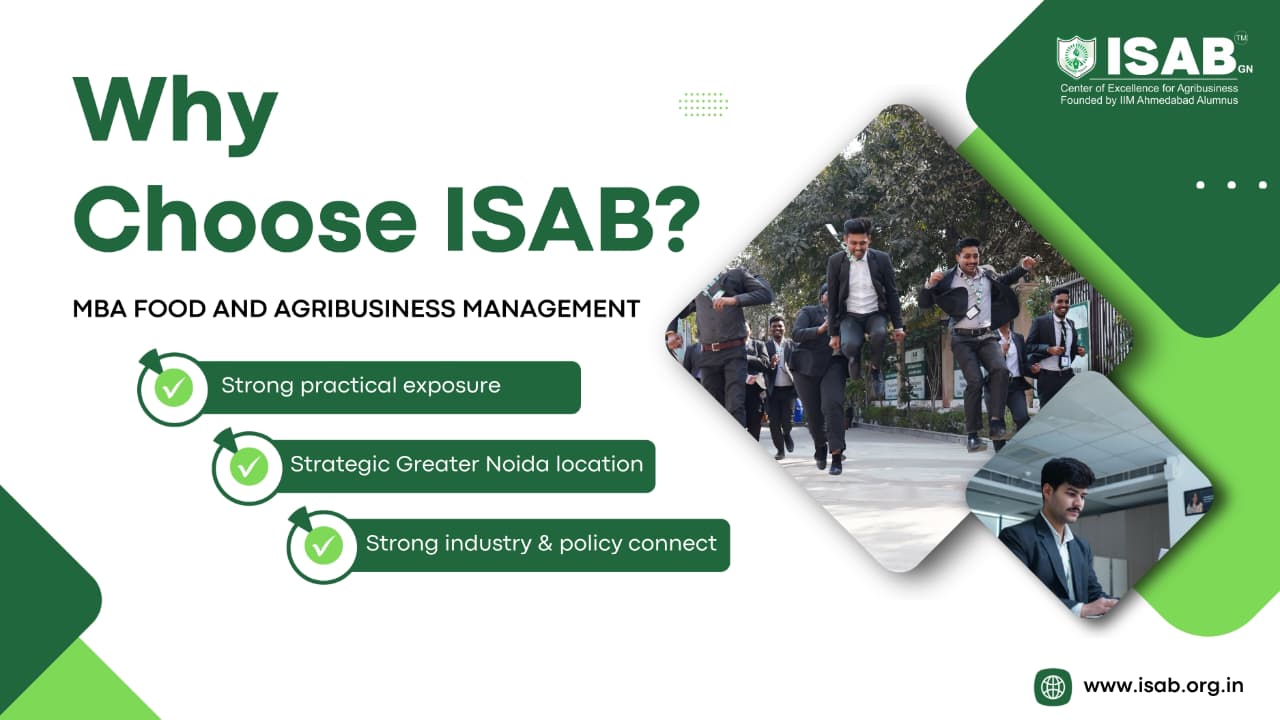
Majoring in an MBA in agriculture is a feasible move for students who desire to work at the nexus of farming, food systems, supply chains and the rural markets. As opposed to general management degrees, an agriculture-oriented MBA must expose them to actual systems of production, agri-markets, and policy-based settings. That is why campus location and academic ecosystem determine a significant contribution to the formation of learning outcomes and career readiness.
Greater Noida has over time become a hub of higher learning because it is close to the research institutions, agribusiness clusters, and policy institutions in the country. To students looking to study agribusiness colleges in India, this geographical benefit can be translated into an added benefit of learning and interaction with the industry.
Food and Agribusiness Management Academic Structure
MBA in Food and Agribusiness Management is aimed at integrating the basics of management with the economics of agriculture and food, value chains, agri-input markets, and sustainability. Subjects of agri-marketing, rural finance, supply chain management, food processing economics, and agri-policy analysis are usually found in programs offered by MBA in agri business management.
The programs ABM should be based on as per ICAR guidelines are supposed to be a blend between classroom and field-based elements such as rural immersion, live projects, and agribusiness case studies. This would equip students to work in cooperatives, agri-input companies, food processing firms, consulting and development organizations.
Exposure and Practical learning in the industry
The degrees of practical exposure are one of the most significant distinguishing factors between the College of Agribusiness Management in Delhi and NCR. Food and agribusiness is an area of study that cannot just be performed purely on theoretical knowledge. To learn about mandi systems, farmer-producer organisations (FPOs) and contract farming models and agri-logistics, one has to be on ground.
Conformity to National Agriculture and Food Trends
India is also the largest milk, pulses, and spice producer in the world and second largest producer of fruits and vegetables. The push towards agribusiness planning and management, through such government programs as the Pradhan Mantri Kisan Sampada Yojana, and agri-exports have led to heightened demand for trained professionals in that area.
When students are studying MBA colleges in India, they usually wonder whether such changing trends are represented in the curriculum. The above programs related to food security, sustainability, agri-technology, and value addition are aimed at ensuring that the graduates do not become irrelevant in a fast evolving industry.
Conclusion
Anticipation of selecting a proper institution for the MBA in Food and Agribusiness Management is based on the level of academics, practical exposure, geographical benefits, and relevance to the Indian agri-food ecosystem. ISAB is a Greater Noida-based institution providing specialised training in food and agribusiness management. The institute is dedicated to the combination of management education and agricultural systems and industrial exposure and policy awareness and caters to the needs of the students who intend to pursue their long-term careers in the agribusiness and food industry of India.